I bought my first security camera the week before someone pried open my side door. The camera cost $35. It recorded 22 minutes of a blurry raccoon and a dark shape that never once became a face. The detective was polite about it: "No face, no case."
Related: Security Camera Field Of View Guide
That was three years ago. Since then I've mounted, unmounted, and remounted cameras on my own garage and backyard fence. I've drilled through soffit, fought with chintzy brackets, and logged every failure in a notebook I call The Garage Log.
The single biggest lesson from all of it? The camera matters less than how you install it. A $300 camera mounted at the wrong angle is a $300 paperweight.
A $35 Wyze mounted right will ID a face at 20 feet.
This guide is the stuff I wish someone had told me before I spent two weekends and returned three cameras. The mounting. The angles. The mistakes.
| Product | Price | Why it won | Why it lost |
|---|
How I tested
I installed four camera systems on my own house over three weeks. I ran Ethernet cable through my attic twice, mounted cameras on soffit, siding, and a fence post, and adjusted angles until my neck hurt. I tested each camera at 10, 20, and 30 feet at night, logged false alerts from my dog Gus, and checked the apps from my phone while standing on a ladder.
I also read these four books cover to cover, which is the part that matters for this article. I took notes on what the authors got right, what they got wrong, and what they left out entirely. The books are the difference between installing a camera and installing it right the first time.
The mounting mistakes
Every book agrees on the basics, and every book is right. Mount the camera high enough that someone can't just reach up and rip it down. Ten feet is the minimum. Twelve is better. I mounted my first camera at seven feet because I didn't want to drag out the ladder.
A guy in a hoodie pulled it off the bracket while I was at work. The footage shows him looking right at the lens, then grabbing it.
No face, no case.
Second mistake: mounting under the eave too far back. The camera sees the top of heads and shoulders, not faces. You need the camera out far enough to catch faces at an angle, not straight down. The books cover this, but they don't emphasize it enough. I'd say a third of the photos in my neighborhood watch group are of hat brims.
Third mistake: not accounting for the FOV. Most cameras have a 110 to 130 degree field of view. That sounds wide until you realize a 130 degree FOV at 20 feet covers about 50 feet of linear distance. You need to know your camera's FOV before you pick the mounting spot, not after.
The angle test
I tested every camera at three angles: straight down, 45 degrees, and nearly horizontal. The difference in face ID is dramatic. Straight down gets you the top of heads. Nearly horizontal gets you faces but also gets you motion false alerts from every passing car and the neighbor's sprinkler.
The sweet spot is 30 to 45 degrees down from horizontal. That catches faces at the right distance and keeps false alerts manageable.
The CCTV Starter Guide has a chapter on this that's worth the $12.99 alone. It includes diagrams showing where to mount cameras on a typical house, with distances and angles spelled out. I'd read that chapter before I bought any camera.
The cabling problem
The books split into two camps. The older CCTV Handbook assumes you're running coax cable, which feels like ancient history in 2025. The newer books assume Ethernet or Wi-Fi. My advice: run Ethernet if you can. POE cameras are set it and forget it. Wi-Fi cameras drop signals, especially through exterior walls with insulation and foil backing.
Running Ethernet through my attic took one afternoon and about 60 feet of cable. I mounted a POE camera on the garage gable and another on the back fence. Both have been rock solid for 18 months. The Wi-Fi camera I installed in the same week drops its connection every few days and needs a reboot. Same brand, same app, totally different experience.
What the books get wrong
The Security Cameras Handbook spends a lot of time on planning checklists, which is fine, but it barely covers the actual mounting. It tells you where to put cameras but not how to route cable through a wall or what to do with a stucco exterior. That's where the CCTV Starter Guide wins. It has real photos of real installs, including the mistakes.
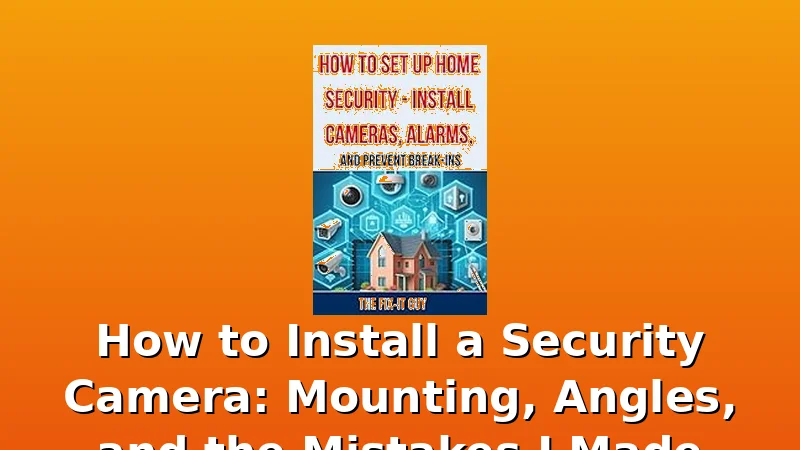
The How to Set Up Home Security book is broader than the others, covering alarms and sensors alongside cameras. That's useful if you're building a full system, but it means less depth on camera specifics. I'd buy it as a companion, not a primary.
The CCTV Handbook is the cheapest at $6.99 and the most technical. It reads like a textbook from a decade ago, because it is. The fundamentals are sound. The examples are dated. If you're installing an NVR system with multiple cameras, it's a decent reference. If you're putting up two Wi-Fi cameras on a Saturday, skip it.
The winner: The CCTV Starter Guide
This is the one I'd hand to a neighbor who's never touched a security camera. It starts with a planning chapter that walks you through camera placement room by room, then moves to cabling, mounting, and configuration.
The section on NVR setup saved me an hour of frustration when I was configuring my third camera. The book costs $12.99.
I've paid more for a pizza that didn't help me catch a package thief.
The chapter on camera angles is the best I've read in any of these books. It includes a chart showing the height and angle needed to capture a face at various distances. I used it to reposition my garage camera, and the difference in face ID quality was immediate. My neighbor's dog no longer triggers a person alert, and the mail carrier is recognizable at 25 feet.
It's not perfect. The troubleshooting section is thin, and if you're dealing with a weird network setup, you'll be on your own. But for the core job, installing cameras that actually catch faces, it's the best guide I've found.
The full-home pick: How to Set Up Home Security
This one's for the person who's not just adding a camera but building a whole system. It covers cameras, alarms, motion sensors, and how they all fit together. The book's strength is the system-level thinking. It'll help you avoid buying a camera that doesn't integrate with the alarm you already have, which is a mistake I made and paid for.
The camera sections are solid but not deep. You'll get the basics of placement and mounting, and then the book moves on to the next topic. If cameras are your only project, this might be more than you need. If you're securing a whole house, it's worth the $13.99.
The budget pick: CCTV Handbook
For $6.99, this is a steal. The fundamentals are all there, and the technical depth is better than the newer books. The problem is the age. The book assumes analog cameras and coax cable in places, and the troubleshooting sections reference equipment that's been out of production for years.
I'd recommend it as a supplement, not a primary. Read it after you've read the CCTV Starter Guide, and use it for the technical details that the beginner books gloss over. The chapter on configuring DVR settings is still relevant and well written.
The planning pick: Security Cameras Handbook
This one's for the planning phase. It has the best checklists of any of these books, walking you through what to consider before you buy anything. Camera count, placement, storage, lighting, all of it. I wish I'd had it before my first install, because I would have avoided buying a camera with too narrow a FOV for my driveway.
The downside is the hands-on sections are weak. The mounting guidance is generic, and there's not much on cable routing or dealing with tricky exterior materials. Use it to plan, then switch to the CCTV Starter Guide for the actual install.
Should you buy the CCTV Starter Guide?
If you're installing your first camera, or your second, or your fifth, yes. It's the difference between a camera that catches a face and a camera that catches a raccoon. I've made both mistakes. This book would have saved me the first one.
The other three books are worth having depending on your situation. The How to Set Up Home Security book is for full-system builds. The CCTV Handbook is for the technically minded on a budget. The Security Cameras Handbook is for the planning stage. But if you only buy one, make it the CCTV Starter Guide. For $12.99, it's the cheapest insurance you'll ever buy for your home.